Bin-Level Visibility
Track inventory by warehouse, client, SKU, barcode, and bin.
Stacket helps high-SKU warehouses pick the right item and ship with confidence.
Hidden cost of SKU complexity
The more SKUs you manage, the easier it becomes to pick the wrong size, color, variant, or barcode. Those errors create reships, refunds, labor waste, and client frustration.
Bin-level visibility
Track inventory by warehouse, client, SKU, barcode, and bin.
Barcode validation
Confirm the right item at receiving, picking, packing, and counts.
Order accuracy
Reduce mistakes from look-alike products and printed pick lists.
Dashboard control
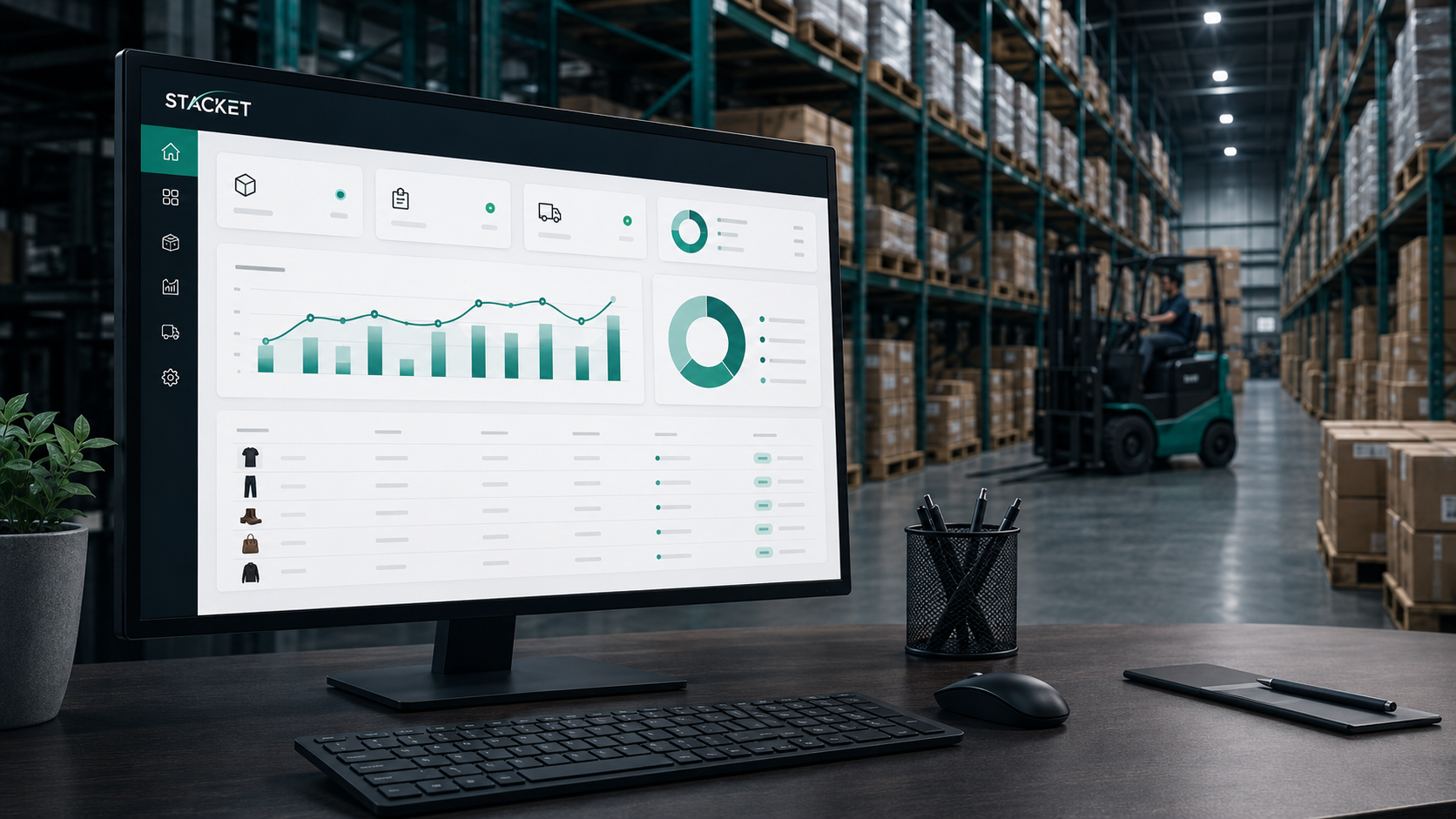
See inventory movement, order flow, picking progress, and bottlenecks.
Stacket tracks inventory by warehouse, client, SKU, barcode, and bin so your team knows exactly where product sits and what is available to promise, pick, or replenish.
Pick multiple orders efficiently while keeping each item assigned to the correct order, tote, or bin for cleaner packing and fewer fulfillment mistakes.
Operational controls
Your team does not have to guess from product names, look-alike packaging, or printed pick lists. Stacket helps operators validate the right barcode before inventory moves to the next step.
Stacket confirms the right item at every step so high-SKU warehouses stop depending on memory, spreadsheets, or manual checks.
Track inventory by warehouse, client, SKU, barcode, and bin.
Confirm the right item at receiving, picking, packing, and counts.
Reduce mistakes from look-alike products and printed pick lists.
Pick multiple orders efficiently while keeping each item assigned to the correct order or bin.
See inventory movement, order flow, picking progress, and bottlenecks.
Apparel 3PL WMS FAQ
Answers for apparel 3PLs, fulfillment centers, and omnichannel operators evaluating warehouse management software for SKU matrix control, billing automation, integrations, reverse logistics, and multi-client fulfillment.
Questions for 3PLs managing style, color, size, lot, batch, bundle, and kitting complexity.
Stacket WMS is an apparel-focused warehouse management system for 3PLs, fulfillment centers, and omnichannel operators. It helps teams manage inventory, orders, receiving, picking, shipping, returns, client portals, and billing while handling the style-color-size matrix complexity that generic WMS platforms often miss.
Stacket WMS is designed around apparel profile and matrix management. Warehouses can track products by style, color, size, variant, and other configurable attributes so teams can receive, locate, pick, pack, and report on thousands of fashion SKUs without losing visibility across the matrix.
Yes. Stacket WMS supports client-specific pre-packs, bundles, kits, and value-added service workflows. A 3PL can configure operational rules by merchant or brand instead of forcing every apparel client into the same fulfillment process.
Yes. Stacket WMS supports specialized inventory control, including lot and batch tracking where required. This helps apparel and consumer-goods 3PLs manage traceability, quality control, replenishment, and inventory health across one or more warehouses.
Questions about client separation, portals, multi-site operations, data ownership, and security.
Yes. Stacket WMS supports multi-client and multi-warehouse operations for third-party logistics providers. Each merchant can have a dedicated client portal while the 3PL manages shared warehouse execution, inventory visibility, order workflows, and reporting from one operating system.
Stacket WMS is designed with strong client data separation, including private database architecture per 3PL client. This helps prevent data overlap between merchants and gives 3PL operators a secure foundation for multi-client fulfillment.
Yes. Stacket WMS includes a client-side portal that can be presented with the 3PL's brand experience. Clients can view inventory, orders, returns, reporting, and operational updates without relying on manual spreadsheets or email requests.
Yes. Stacket WMS is built so the 3PL retains ownership of its operational and client data. Access controls, secure architecture, and role-based visibility help keep warehouse, merchant, and reporting data protected.
Stacket WMS uses secure access controls, encryption-minded architecture, and client data isolation to protect warehouse and merchant data. The platform is designed for 3PL environments where confidentiality between clients is essential.
Questions about 3PL billing automation, accessorial charges, SLAs, and revenue leakage.
Yes. Stacket WMS can capture accessorial and value-added service charges such as labeling, poly-bagging, kitting, returns handling, and other billable warehouse activities. This helps 3PLs reduce missed charges and improve billing accuracy.
Yes. Stacket WMS can support separate automated billing rules for returns processing and reverse logistics work. This allows a 3PL to recover the true cost of inspection, grading, restocking, refurbishment, and client-specific return workflows.
Yes. Stacket WMS supports customer-specific billing rules so each 3PL client can be invoiced according to its contract, rate card, SLA, services, and operational requirements.
Yes. Stacket WMS allows 3PLs to configure client-specific workflows, service rules, and billing logic. This helps operators manage different merchants, priorities, and service-level agreements without relying on manual tribal knowledge.
Questions about ecommerce, ERP, carrier, accounting, API, and new-client onboarding workflows.
Stacket WMS supports integrations with ecommerce, ERP, shipping, accounting, and client systems. Native and supported integration paths include Shopify, WooCommerce, BigCommerce, NetSuite, carrier platforms, and API-based connections for additional merchant systems.
Stacket WMS is designed for 3PL onboarding workflows where every client may use a different tech stack. Integrations can synchronize orders, inventory, returns, fulfillment events, and reporting data so warehouse teams do not have to re-key client information.
Stacket WMS supports fast onboarding using structured warehouse and client data such as CSV or Excel files. The goal is to help apparel 3PLs move from spreadsheets or legacy workflows into a live WMS implementation with minimal disruption.
A 3PL can onboard a new merchant by creating the client account, configuring the portal, importing product and inventory data, and connecting required integrations. Timing depends on operational complexity, but Stacket WMS is designed to make new-client launches faster and more repeatable.
Questions about barcode scanning, D2C picking, B2B workflows, returns, and daily warehouse execution.
Yes. Stacket WMS supports mobile barcode scanning for receiving, put-away, replenishment, picking, packing, cycle counts, and other warehouse tasks. Barcode-driven execution helps reduce mis-picks and improve inventory accuracy.
Stacket WMS helps high-volume D2C apparel fulfillment teams pick accurately across dense SKU matrices, multiple sizes, colors, brands, and sales channels. Real-time inventory, barcode scanning, and configurable workflows help teams keep pace with order volume while reducing errors.
Stacket WMS is built for 3PL operations that serve both D2C and B2B apparel clients. It can support structured warehouse workflows, client-specific rules, and operational controls that help teams prepare orders for retailer requirements, routing expectations, and outbound accuracy.
Stacket WMS streamlines reverse logistics with workflows for receiving returns, inspecting items, grading condition, restocking sellable inventory, and capturing return-related billing. This helps apparel 3PLs reduce return backlogs and recover inventory faster.
Stacket WMS provides real-time inventory visibility across locations, clients, warehouses, and channels. Teams can track stock movement through receiving, storage, picking, returns, and shipping so physical inventory and digital storefronts stay aligned.
Questions about analytics, scaling facilities, implementation cost, and why Stacket is different.
Yes. Stacket WMS is designed to support growing 3PL operations, from smaller apparel warehouses to larger multi-client fulfillment centers. The platform can scale with additional clients, warehouses, users, and order volume.
Yes. Stacket WMS is cloud-native and designed to scale as a 3PL adds new facilities, merchants, integrations, and operational workflows. It helps operators grow without rebuilding their warehouse technology stack every time they add a client.
Stacket WMS provides dashboards and customizable reports for order fulfillment, inventory levels, warehouse productivity, client activity, returns, billing, and operational performance. This gives 3PL leaders better visibility into accuracy, labor, revenue, and service levels.
Stacket WMS is positioned around transparent pricing that can include implementation, integrations, training, support, and core WMS functionality. This helps 3PLs understand the total cost of ownership instead of being surprised by hidden implementation or integration fees.
Stacket WMS was built around apparel 3PL problems: SKU matrix complexity, reverse logistics, value-added service billing, client portals, multi-client data separation, and high-accuracy warehouse execution. It is designed for operators who need apparel-specific workflows rather than a generic inventory system.
Review your current workflow with our team and see how Stacket can support your inventory, fulfillment, returns, client visibility, and billing requirements.
Ready to transform?
See Stacket in action