Stacket vs ShipHero: The Right WMS for Your 3PL
ShipHero bet on scale and carrier reach. Stacket bet on what makes a 3PL hard to run: client-specific billing, apparel-level SKU complexity, and returns that need a decision, not just a checkbox. Compare them side by side, with sources cited.
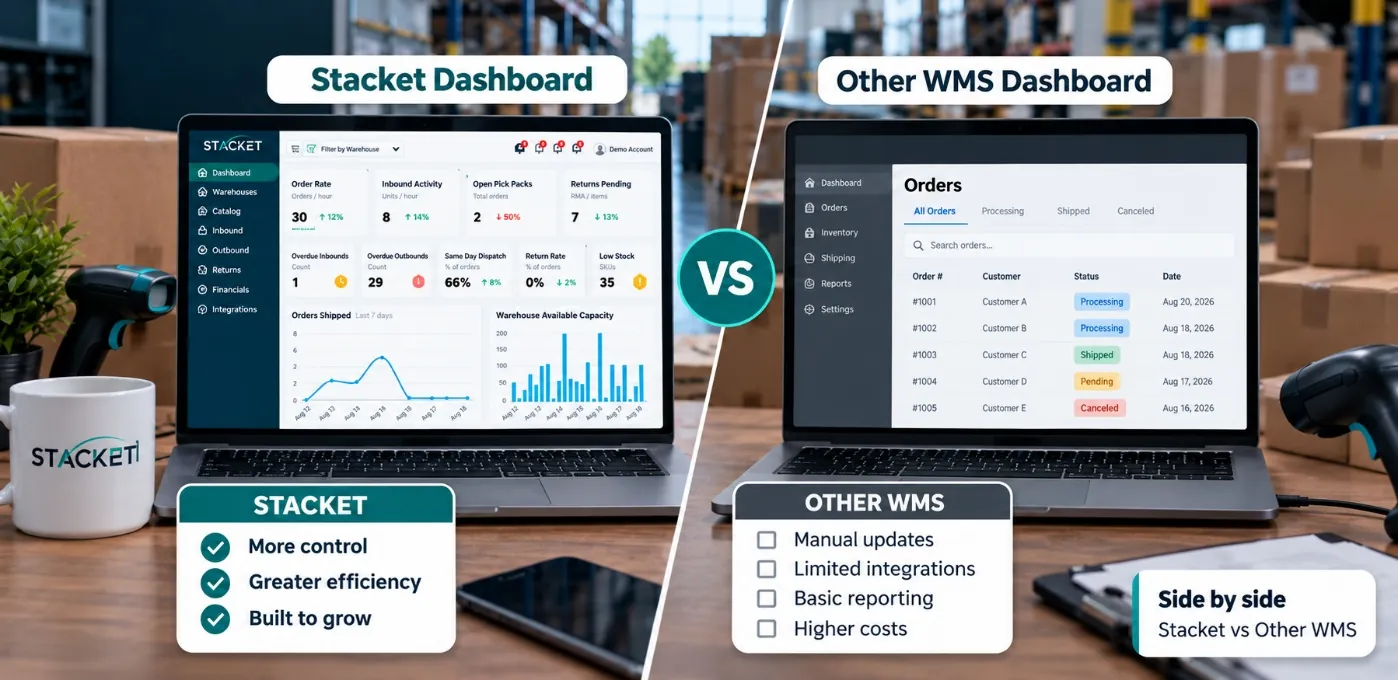
Stacket or ShipHero: How Should You Decide?
If you run a multi-client 3PL, with five, ten or thirty clients on as many different rate cards, and half your inventory is a style-color-size matrix instead of a flat SKU, that's the warehouse problem Stacket was built to solve. You get connected with receiving, inventory, fulfillment, returns and billing, with published plans from $749/month.
ShipHero is a capable platform with years of head start on high-volume ecommerce, broad carrier coverage and a structured onboarding program. It fits best when you run one operating model at scale, and its 3PL plan starts at $2,145/month.

Most 3PLs start looking for a ShipHero alternative when client requirements, rate cards, fulfillment models and daily exceptions stop fitting neatly into the system they started with. Billing is usually where it shows up first.
Stacket Is Built for These 3PL Operations
Stacket is backed by Dream Beyond, a software engineering company with 25+ years of experience building enterprise-grade systems. It fits best when a general-purpose platform gives you less flexibility than your operation needs.
Small & Mid-Sized 3PLs
Connected receiving, inventory, fulfillment, returns and billing, without configuring an enterprise-scale platform to get there.
Complex 3PL Billing
Different clients need genuinely different rate rules, tied to the warehouse activity that actually happened, not a shared template.
Apparel & High-SKU Warehouses
Style, color and barcode complexity across bins and clients, where the bottleneck is variants, not raw order volume.
Returns-Heavy Operations
3PLs where returns are a big share of daily work and need condition grading, not just a "mark as returned" button.
Stacket vs ShipHero: Side-by-Side Comparison
Here's what each platform does on the factors that usually decide on a WMS switch.
Designed for
Stacket
3PLs, fulfillment centers, high-SKU warehouses and mixed DTC/B2B operations, with a focus on small and mid-sized 3PLs
ShipHero
3PLs and high-volume ecommerce brands at scale. ShipHero says it processes over $15 billion a year in sales for its customers.
Published 3PL starting price
Stacket
$749/month Standard, $1,249/month Growth, Enterprise custom
ShipHero
$2,145/month (WMS for 3PLs plan)
3PL billing
Stacket
Client-specific rate rules attached to each client's account and tied to warehouse activity, on Growth and Enterprise
ShipHero
Configurable Billing Profiles (recurring, receiving, storage, shipments, picking, returns, ad hoc fees), one per client per warehouse and shareable across accounts
Billing traceability
Stacket
Every charge traces back to the warehouse job that created it
ShipHero
Mature billing and charge management
High-SKU / apparel
Stacket
Inventory tracked by warehouse, client, SKU, barcode and bin, with style, size and color as variants from receiving through returns
ShipHero
Handled through general inventory management and configurable picking. The public materials reviewed don't describe a dedicated style/size/color feature.
Returns
Stacket
Condition grading (sellable, damaged, refurbishable, exception) with barcode-validated restocking
ShipHero
Dedicated Returns Management module plus a Loop Returns integration
DTC & B2B
Stacket
DTC, B2B and wholesale orders run from one inventory pool, with no separate system to run
ShipHero
Dedicated Wholesale/B2B workflow, case and pallet picking, SPS Commerce EDI
Picking
Stacket
Pickers follow an optimized route, and every pick is confirmed by barcode scan
ShipHero
Advanced high-volume picking, including location-aware routing
Client portal
Stacket
Seller portal included on every published plan, no upsell
ShipHero
Unlimited customer portals on the 3PL plan
Accounting
Stacket
QuickBooks integration built for the 3PL billing handoff, on Growth and Enterprise; NetSuite supported
ShipHero
NetSuite integration; QuickBooks Online for eligible 3PL accounts
Implementation
Stacket
Import SKUs and clients from a spreadsheet; onboarding scope grows with plan; Enterprise includes dedicated onboarding and support
ShipHero
Sandbox account, setup and training, dedicated account manager; Enterprise adds a CSM
SKUs & orders
Stacket
No published SKU cap; shipments scale by plan: 5,000/mo Standard, 20,000/mo Growth, unlimited Enterprise
ShipHero
Unlimited SKUs and orders on the 3PL plan
Carriers
Stacket
UPS, FedEx and DHL; 1 connection on Standard, 3 on Growth, unlimited on Enterprise
ShipHero
Broad network, including Asendia, Australia Post, Canada Post and Deutsche Post
ShipHero figures come from ShipHero's published product and pricing pages, reviewed September 7, 2026. Stacket figures come from Stacket's pricing and integrations pages. Pricing and capabilities change, so confirm current terms with each vendor before deciding.
Where Stacket Has the Operational Advantage
The difference shows in the workflows that affect billing accuracy, inventory control, client management, and day-to-day 3PL operations. Stacket's advantage isn't one more feature. It's how the features fit together into a more controlled 3PL workflow.
Billing Structure
ShipHero assigns profiles to an account. Stacket attaches rate rules directly to each account, so changing one client's setup can't affect another's.
Rate Flexibility
Shared profiles get complicated when clients need different pricing. Stacket keeps client rates isolated, so custom fees, exceptions and account-level pricing don't touch other customers.
DTC and B2B in One Operation
Stacket lets DTC, B2B, and wholesale orders work from the same inventory pool, so operators don't manage each channel as a separate inventory path.
SKU and Variant-Level Control
Unlimited SKUs tell you how many items you can store. Stacket goes further, tracking barcode and bin for every size and color, so you know what's actually stored and where.
Returns That Lead to an Action
Stacket connects the return to the next warehouse action: restock, refurbish, quarantine or dispose. Items are graded before they return to available inventory.
Client Visibility Built In
The Seller portal is included on every Stacket plan, so clients see their own inventory and orders without portal access becoming another feature to evaluate later.
Stacket Pricing vs ShipHero Pricing: What Would Your 3PL Actually Pay?
Stacket publishes three plans, starting at $749/month. ShipHero publishes a starting price of $2,145/month for its WMS for 3PLs plan, without publishing everything that price depends on, such as onboarding scope, carrier account fees or what happens at plan limits.
Stacket's three published plans
Standard
$749/mo
For small 3PLs starting with ecommerce or B2B fulfillment.
Growth
Most Popular$1,249/mo
For growing 3PLs managing more clients, SKUs and workflows. Adds client-specific billing automation and the QuickBooks integration.
Enterprise
customs
For high-volume 3PLs with complex, multi-warehouse operations.
How Stacket pricing scales with your warehouse
Every plan scale on limits you can check against your own operation, not vague "contact sales" tiers.
| Standard | Growth | Enterprise | |
|---|---|---|---|
| Users | 5 | 15 | Unlimited |
| Warehouses | 1 | 3 | Unlimited |
| Shipments | Up to 5,000/mo | Up to 20,000/mo | Unlimited |
| Carrier connections | 1 | 3 | Unlimited |
| Seller portal | Included | Included | Included |
| Client-specific billing & QuickBooks | — | Included | Included |
The fair price comparison
Like for like on billing:
client-specific billing starts on Stacket Growth. At $1,249/month vs ShipHero's $2,145/month, that's about $896/month, or roughly $10,700/year, less for the feature that sets Stacket apart.
If you don't need client-specific billing yet:
Stacket Standard at $749/month is about $1,396/month (roughly $16,700/year) below ShipHero's starting price. Standard has lower limits (5 users, 5,000 shipments, 1 warehouse), so check them against your volume.
What ShipHero's price includes:
unlimited SKUs, orders and customer portals, and a broad carrier network. Stacket's Enterprise plan is unlimited on users, warehouses, shipments and carrier connections.
What to ask before comparing any WMS price
Useful for any vendor. Bring these to every sales conversation.
Do users and warehouses change the price?
Ask whether adding staff accounts or a second facility forces an upgrade or a separate contract.
Are integrations included?
Check whether ecommerce, carrier, and accounting integrations are bundled or billed as extras.
Is implementation charged separately?
Ask what setup, configuration and training cost beyond the monthly rate, and get it in writing.
How does 3PL billing work?
Find out whether rate cards are client-specific or shared, and what happens to other clients when you edit one.
What does migration involve?
Ask what's needed to move SKUs, clients, rate cards and historical data before a go-live date is set.
What happens if you exceed limits, and what support is included?
Get overage rules for shipments, users and warehouses before you sign, and find out whether you get a dedicated account manager.
3PL Billing: Client-Specific Rate Rules vs Shared Profiles
Billing is usually the first thing a growing 3PL outgrows. The core question is how a charge gets created, and whether one client's setup can affect another's.
Stacket attaches rate rules directly to each client's account, kept isolated by default.
You can add a custom fee or exception for one client without touching anyone else's rates, and every charge traces back to the warehouse event that created it, so nothing gets billed without proof. This is the core of Stacket's 3PL billing automation, and Stacket's QuickBooks integration carries the result into accounting on Growth and Enterprise.
ShipHero assigns Billing Profiles, one per client per warehouse, and a profile can be shared across multiple clients.
Update it once and every client assigned it changes. That's efficient when clients share rate structures, and a liability at the moment one client needs an exception.
What both platforms cover
Receiving, storage and fulfillment:both turn warehouse activity into billable line items tied to a rate card.
Returns and accessorials:return handling, relabeling and one-off exceptions are billable on both.
Recurring and minimum fees:a published billing category on both.
One fair note: ShipHero automatically compares quoted and actual carrier costs and bills the difference, a documented strength.
Stacket vs ShipHero: Compare the Workflows That Matter Most
Fulfillment mix, SKU complexity, returns, client visibility and rollout. Pick out a topic to see how each platform handles it.
DTC & B2B
DTC, B2B and Mixed Fulfillment
Many growing 3PLs no longer run a single fulfillment model. A warehouse may ship individual ecommerce orders during the day, and palletized wholesale orders for the same client, sometimes for the same SKU.
DTC, B2B, wholesale, and marketplace workflows run in the same warehouse environment. One client can ship single-item DTC orders and palletized B2B orders from the same inventory pool at the same time, and B2B isn't a bolt-on.
A dedicated Wholesale/B2B workflow, full case and pallet picking and an SPS Commerce EDI integration for retailer-compliant orders, alongside standard ecommerce order management. Its scale (over $15B in customer sales, and 1 in 80 US ecommerce packages by its own figures) points to strong high-volume DTC and marketplace fulfillment.
Picking, briefly
Stacket guides pickers along an optimized route and confirms each pick by barcode scan. See the shipment pick plan. ShipHero offers advanced high-volume picking with location-aware routing.
Integrate With the Tools You Already Run
Connect Stacket to support ecommerce platforms, marketplaces, accounting tools and major carriers, tied directly to 3PL billing. See all WMS integrations.










ShipHero has a broader carrier network, including many regional and international carriers. If you rely on carriers beyond UPS, FedEx and DHL, check that before you decide.
Who Should Choose Stacket Over ShipHero?
The decision rarely belongs to one person. Here's what each role usually weighs.
3PL Owner
Looks past the subscription price to the real operating cost: billing leakage, manual reconciliation, client retention, and how easily the warehouse can scale. Stacket's account-level controls and operational visibility make those economics easier to manage.
The decision comes down to the operation. If the priority is simply getting orders out, both platforms belong in the conversation. If the priority is controlled billing, unified inventory workflows and flexible client management, Stacket is the stronger fit.
Six Questions That Actually Decide This
Answer these about your own warehouse, not about either vendor's marketing page.
How complex is your 3PL billing, really?
If even two clients need different rates for the same job, you need a system built for that. Stacket gives every client their own rate rules.
Are you DTC, B2B, or genuinely both?
Stacket runs both from the same inventory, so you're not managing two systems.
How much of your inventory is actually a variant?
Count the SKUs that are the same item in a different size or color. Stacket tracks each one separately.
What happens to a return the moment it arrives?
It should be checked and sorted right away. Stacket grades it before it goes back on the shelf.
How many clients ask for something nonstandard?
Every client eventually wants a one-off charge. Stacket lets you add it for one client without touching anyone else's rates.
What does migration touch?
SKUs, clients, rate cards and integrations. Stacket's team maps all of it with you before go-live.
Trusted by Modern 3PL
Warehouse Operators and Fulfillment Centers.
Stacket gave us visibility we never had before. Billing disputes dropped, reporting got faster, and our warehouse finally felt under control.
Stacket 3PL WMS has revolutionized how we manage our inventory. Real-time tracking and analytics gave us unparalleled control over our supply chain.
Since integrating Stacket, we've seen a 30% increase in order fulfillment speed and accuracy. Bin-level precision made inventory management a breeze.
Implementing Stacket was a strategic move that paid off beyond expectations. Faster, more accurate shipping has driven our growth ever since.
Frequently Asked Questions
Short, direct answers to what 3PLs ask when comparing the two.
Stacket is built for small and mid-sized 3PLs that need billing tied to each client, variant-level tracking for apparel and high-SKU catalogs, and returns handled as a graded workflow. ShipHero is built for high-volume ecommerce brands and established 3PLs, with deep carrier reach and structured onboarding.
See Whether Stacket FitsYour ShipHero Comparison
Bring your actual client list, rate cards and SKU mix. We'll show you what maps cleanly, what needs configuration, and what we can't do yet. Or see what the equivalent setup costs on Stacket.
ShipHero pricing and feature details are based on publicly available information reviewed on September 7, 2026. Pricing and plan details may change; confirm current terms directly with each vendor.
ShipHero is a trademark of its respective owner. Stacket is not affiliated with, sponsored by, or endorsed by ShipHero. References to ShipHero are for identification and comparative purposes only. Product features, integrations, and pricing are based on publicly available information and may change. Verify current details directly with the respective vendor.